Tuesday, April 16, 2013

The Gran canal


  Time: 1723-24
  Style: Rococo
  Artist: Diego Velázquez
  Material and Technique: Oil on canvas
  Location: Ca´Rezznico museum

  Iconographic Analysis

Name: The Gran Canal of Venice
Type of painting: It is a Rococo painting by canaletto wich was for a venetian noble wich commisioned  to canaletto four painting, this is one of these four painting.

 Formal Analysis: in the painting appear the principal canal of venice, view to the northeast from the Palazzo Balbi to the Rialto Bridge, it´s  a very realistic painting carasteristic of canaletto style.
Composition, space and decoration:
Size: 144 × 207 cm


La Sorbona


Time: 1635 and 1642.
Style: barroque
Artist: Jacques Lemercier
Material and technique: 
Location: Place de la sorbone


Tuesday, April 9, 2013

            LAS MENINAS

Time: 1656.

Style: Baroque.

Artist: Diego Velázquez.

Material and technique: Oil on canvas.

Location: Prado museum,Madrid,España.


                                               Iconographic Analysis
 Name: Las Meninas or La familia de Felipe IV.

 Type of painting: It´s a baroque painting by Diego Velázquez and it´s   considerate the master piece of the painter of the golden century.

 Formal Analysis:
 Composition,space and decoration:


Thursday, March 14, 2013

Los Borrachos & La Mulata


              Los Borrachos or The Triumph of Bacchus


  Time: 1628-1629
  Style: Baroque
  Artist: Diego Velázquez
  Material and Technique: Oil on canvas
  Location: Museo del Prado, Madrid


  Iconographic Analysis

Name: Los Borrachos or The Triumph of Bacchus
Type of painting: It is a Baroque painting by Velázquez which was painted for Philip IV and Velázquez was paid 100 ducats.


  Formal Analysis

Composition, space and decoration: There is the very illuminated Bacchus figure, closer to the Italian style by Caravaggio. There are classicist style and the figures are immersed in chiaroscuro. There are also some elements that give naturalism to the painting such as the bottle and the pitcher.
Size: 165 cm x 225 cm
Points of interest:In the picture, the god is represented as a person within the small celebration, but his skin is clearer than the other ones, to be recognized more easily.


  Meaning

In the Baroque, Baco was seen as a liberator of the man's daily life. So, here we have a kind of initiation rite ceremonial wine, where all the drunks laugh. It could be a parody of that initiation Velázquez wanted to do, influenced by Rubens.


La Mulata or The Kitchen Maid with the Supper at Emmaus


  Time: 1620-1622
  Style: Baroque
  Artist: Diego Velázquez
  Material and Technique: Oil on canvas
  Location: Art Institute of Chicago, Chicago


  Iconographic Analysis

Name: La Mulata or The Kitchen Maid with the Supper at Emmaus
Type of painting: It is one of the two Baroque versions of this scene painted by Diego Rodriguez de Silva and Velázquez in his early Seville period.


  Formal Analysis

Composition,space and decoration: We can see a black woman- here the title - after a table, in which they emphasize detailed pots that make an excellent tavern. 
Size: 104.5 cm x 55 cm
Points of interest: In the background is a religious scene which represent the Supper at Emmaus, seen through a window.

  Meaning

Velazquez makes this scene more than a still life depicting a background of sacred history, resource use also in the picture of Christ in the House of Martha.


Tuesday, March 12, 2013

                                   LA VENUS DEL ESPEJO


-Time : between 1599-1660

-Style : Baroque

-Artist : Diego Velázquez

- Material and technique : Oil and canvas

-Location : National Gallery de Londres


Iconographich analysis

Name: The Toilet of Venus o The Rokeby Venus

Type of painting : It's a mythological baroque painting. As is usually in Vélazquez, the woman in the picture is undress.


Formal analysis

Composition,space,decoration : the painting is about  the goddess Venus who is lie on bed and looking in the mirror which is sharped by her song,Cupido. As I've said before, it's a mythological painting and it's a typical work of Vélazquez.


Size of paint : 122 cm × 177 cm

 Point of interest : He doesn't represent the woman in the picture as a goddess;he represent her like a normal woman.


Meaning 

In general, people thing that is emblem the love defeated by beauty.


LA RONDA DE LA NOCHE


-Time :  1642

-Style :  Baroque

-Artist : Rembrandt

-Material and technique : oil and canvas

Location : Rijksmuseum , Amsterdan.


Iconographich analysis

Name:  La compañía militar del capitán

Type of painting :  Its a Baroque painting by Rembrandt  and it's one of the most important in its galery and in the Rembrandt's works because of the techniques used in the painting.


Formal analysis

Composition , space and decoration :  The picture show the nervous and impacient  soldiers beacuse they are stowing in a mission. 

Size of the painting: 359cm X 438cm

Points of interest : the painting has been restored during years.


Sunday, March 10, 2013

Portrait: PHILIP IV
Time: 1623-1627
Artist: Diego Velázquez
Style: Barroque art
Material: Oil on canvas
Techniques: Use of obscurity and neutral King's situation
Location: Prado museum

ICONOGRAPHIC ANALYSIS
Name: Retrato de Felipe IV; translate in english: Portrait of Philip IV
Type of painting: It was a gift for Charles I of England. This portrait like others of Velázquez belong to the first stage that he did it for getting a scholarship and study in Italy

FORMAL ANALYSIS
Composition, space and decoration: This portrait of the young King Philip IV, painted around 1626, is a suberb example of the style of Velázquez in Madrid. It was a test of how the artist returned again and again on his   
                                               canvases, which had always before his eyes on the walls 
                                               of Alcazar
                                               Meaning: Captivated by the portrait that he made a year
                                               ago, Philip IV decided to portray himself again, this time 
                                               in 1626. Both paintings have great similarities to each 
                                               other: (color, position of the king, costumes, stage..)
                                               This painting was to be a gift to Charles I of England. 
                                               Later, the British crown donated it to the U.S goverment

Vault of St.Ignatius Church in Rome ''El Gesú''

Time: 1626
Style: Barroque art
Artist: Andrea Pozzo
Material and techniques: Cutouts were placed on real structures, causing it difficult to indentify the real from the illusory. Pozzo showing how space can be represented on a plane irregular using oblique wings. He stressed the theoretical possibilities of geometric perspective and 
                                                                                           became interested in the 
                                                                                           situation of the focal point.

                                                                                           Location: Rome (Italy)


ICONOGRAPHIC ANALYSIS
Name: Vault of St.Ignatius Church
Type of building: It was built in 1626 and dedicated to the founder of the society of 
Jesús, St.Ignatius of Loyola. It has a single nave with side chapels but if for something stands out is the decoration of the fault and the illusion of deph of the false dome.
                                                                          
 FORMAL ANALYSIS
Composition, space, decoration: Horace Grassi, SJ, chief architect of the Church of San Ignacio de Rome, planned a dome but died before taking it out on the other hand, the money for it was exhausted. Thirty years later, the superiors of the order sought the help of renowned architect and artist, Brother Andrea Pozzo, an expert in the art of perspective. This wanted to paint a dome in the ceiling smooth. It began in October 1684 and was completed for the feast of St. Ignatius, July 31, 1685. The audience that filled the church that day was surprised by the optical illusion that produced the appearance of an actual dome domain thanks to Pozzo had perspective. So the Jesuit Andrea Pozzo again purity illusionistic perspective in their formulations. The false dome of the church of San Ignacio de Rome is paradigmatic of this practice. 
Sizes of the vault: Canvas of 17m wide.
Meaning: In the four corners of the vault are the symbolic figures of the four continents. Europe is represented as a midwife on a horse. Asia is sitting on a camel. The figure of Africa is a woman with African Arab factions, sitting on a crocodile. America is represented as a woman dressed in Indian clothes and in her hand a spear with which hurt one of the giants and behind it a white angel with a flame that symbolizes the expansion of the Jesuits in America

I HOPE YOU LIKE MY POST. HERE YOU ARE
                                                                                                             ANDREA


Thursday, March 7, 2013

          PORTRAIT OF INNOCENT X


Time: 1650
Style: Baroque
Artist: Diego Velázquez
Material and technique: oil and canvas
Location: Galleria Doria Pamphilj in Rome


Iconographich analysis

Name: Pope Innocent X
Type of painting: It is a Baroque painting by Velázquez. One of the virtues of he is that was able to penatre into the personage psychologically to show us hidden aspects of his personality.


Formal analysis

Composition, space, decoration: In this picture, there are lots of characteristics of Baroque painting, such as realism, rich and deep color, intense light and dark shadows.
Size of paint: 140cm - 120cm
Points of interest: Velázquez included his signature in the paper that the Pope have in his hand, although the date you can´t read very well.


Meaning

The figure upright in his chair is very strong, so that mean the higher power the Pope had. Velázquez was a privileged, because it wasn´t easy that a Pope posed for a pintor. Futhermore, Innocent X looks serious, a characteristcs of all of the portrait of this age.


              DOGE´S PALACE


Time: S.IX
Style: Gothic
Artist: Canaletto
Material and technique: The façade was made by a combination of pink and whites marbles, making it more attractive. The palace has a cubic form.
Location: Piazza San Marco, Venice, Italy


Iconographic analysis

Name: Doge´s Palace
Type of building and function: The palace perfomanced three function of vital importance in social and political life of Venice. It was used as a residence for the Doge of Venice, as the seat of city government and as Law Courts. Nowadays the palace has the function as a museum.


Formal analysis

Composition, space, decoration: The palace had a design similar to a castle, with towers and strong walls. Owing to some fires, the building was rebuilt. Nowadays, the public entrance to the Doge´s Palace is a via the Porta del Frumento, in the waterfront side of the building. The inside of the palace is supported by stone arches with an arcade with columns. The main entrance is called Porta della Carta and is the flamboyant style and present in the tympanum a lion of St. Mark kneels before which the Doge Foscari. The arcade of the ground floor rests on thirty six columns and the palace has a big courtyard. And inside the palace, there are lots of painting of famous painters like Tintoretto,Tiziano, etc.


Meaning


It´s a symbol of the glory and power of Venice. And as I said before, this Palace had 3 vitals function and currently it´s just a museum.

Thursday, February 28, 2013


Time: 1581-1582
Style:  manirerismo Italian
Artist; Juan de Bolonia
Material and Technique: marble
Location: Loggia dei Lanzi ( Florence, Italy)

Iconographic analysis

Name: the kidnapping of the Sabina
Type of building and function: the scultures hows a scarty iconography without accesory or symbols convencionals

Formar analysis

Composition, space and decoration: is realized by it an alone black of white marble composed by three pronnient figure
Size: high 4,10m

Meaning

The picture it shows the mythological episode of the " kidnapping of the sabinas" on the part of  founders of Rome


Name: 1599-1600
Style: Baroque
Artist: Caravaggio
Material and technique: Oil on canvas
Location: San luigi dei Francesi( Rome)

Iconographic analysis

Name: The calling of St Matthew
Type of  building: It's a painting of Caravaggio

Formar analysis 
Composition, space and decoration: the saint this one sat in fornt of to able with a group of persons garment as the contemporany ones of Caravaggio as in a scene on taverne
Size: 3,38m x 3,48m

Meaning
 The painting  represent the history that narrates in the gaspeñ as St Matthew


Tuesday, February 26, 2013

Plaza Mayor (Salamanca) & "Las Lanzas"

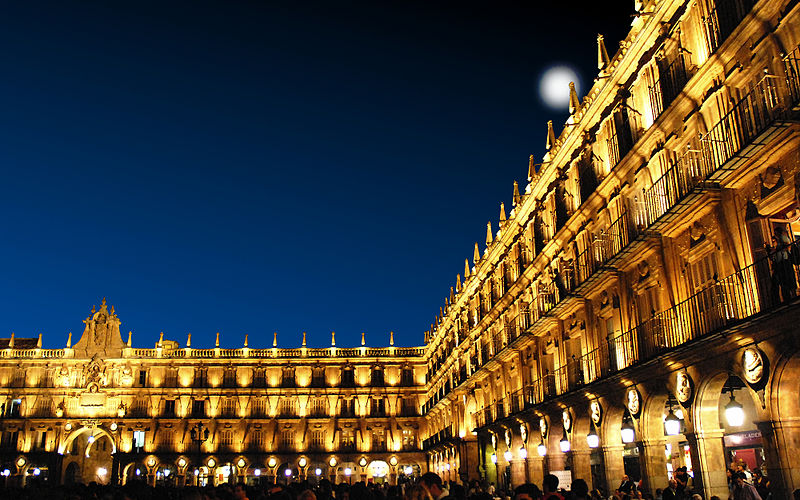
Plaza Mayor in Salamanca

File:Salamanca Plaza Mayor por la tarde.jpg

Time: 1729 - 1756

Style: Spanish Baroque

Artist: Alberto de Churriguera

Material and technique: Sandstone and stone from Villamayor. It's an irregular square surrounded by buildings


File:Plaza Mayor Night.JPG
City Hall
At the front of the plaza we find the City Hall, one of the most important icons of the site. It was designed by Andrés Garcia de Quiñones in a baroque style which match with the plaza.It is lined by restaurants, ice cream parlors, tourist shops, jewelry stores and a pharmacy along its perimeter except in front of the city hall. It is considered the heart of Salamanca and is widely regarded as one of the most beautiful plazas in Spain

Its iconographic program consist of an ensemble of "medallones". These are more than eighty eight small portraits of famous Spanish personalities which represent the history of Spain.


Carlos V de la Plaza Mayor de Salamanca.jpg

Formal analysis

Size: As said before, it forms an irregular square, where none of its sides measure the same. The facade of the City Hall is 82'60 m long, the west, 81'6 m, one more meter than the oriental facade, and the other one 75'59 m. To sum up, the plaza has an are of 6400 square meters, excluding the colomnade.


"The surrender of Breda" or "Las Lanzas"

File:Velázquez - de Breda o Las Lanzas (Museo del Prado, 1634-35).jpg

Time: 1634-1635

Style: Baroque

Artist: Diego Velázquez

Material: Oil on canvas

The picture shows the capture of Breda after its siege, one of the major Spanish successes in the latter stages of the Eighty Years' War. The Spanish army was led by one of the best strategist under his service, Ambrosio de Spinola. The city was the seat of the Orange family, so its oficial was Nassau-Orange. The strategy of Spinola is regarded as a masterpiece. However, the heroic defense defense led to honorable terms of defeat, so Spinola let Duch army to form outsidethe walls of the city. 


Time: 1603-1606
Style: Baroque
Artist: Juan Martinez Montañés
Material and technique: It is made of cedar wood.
Location: Cathedral of Seville


Iconographic analysis
Name: Crist of Clemency
Type of building and function: It was order to build by a canon of Seville for a particular oratory.


Formar analysis
Composition, space and decoration: It represents the God of the Christians when he died in the cross. You can see the blood and the crown of thorns.
Size: heigh 1.90 metres

Meaning: This is very Catholic because is the God of the Christians. This crucifix shows nobility, calm and honour.


Time: 1665-1666
Style: Baroque
Artist: Veermer de Delft
Material and technique: oil on panel
Location: Mauritshuis's museum


Iconographic analysis
Name: The young girl with the pearl 
Type of building: It's a picture of Veermer de Delft


Formar analysis
Composition, space and decoration: a young girl with a headscarf, the pearl is on her ear.
Size: 25.7 x 19cm

Meaning: this painting was important for a novel by Tracy Chevalier. The most important thing of this picture is the pearl that is on the ear of the girl. This can be a symbol of a wedding.

Monday, February 25, 2013


  • MARIA TERESA OF SABOYA.


Historical and artistic context

-Time: In 1710.18th century.

-Style: Baroque.

-Artist: Antoine Coysevox.

-Material and technique: Made of white marble.Architecture.

-Location: Louvre Museum.


Iconographic analysis

-Name: Sculpture of ''María Teresa de Saboya''.Duchess of Borgoña.

-Type of building: Sculpture with the mythological representation of the goddess Diana.It's located in the Louvre Museum but the sculpture come from the Palace of Versailles.


Formal analysis

-Composition, space, decoration: 
This is an usual sculpture of the Baroque art, made up of marble, represented María Teresa de Saboya as the goddess Diana.You know that Diana in the Roman mythology, is the goddess of the hunt, so that's why she is taking a dog.

-Size of the sculpture: 
The sculpture measure about 240 cm.

-Meaning:
The sculpture was created in 1710, a year before the death of María Teresa. In this sculpture the artist wants show the Duchess of  Borgoña such as a protective of the nature and with a wild bearing.


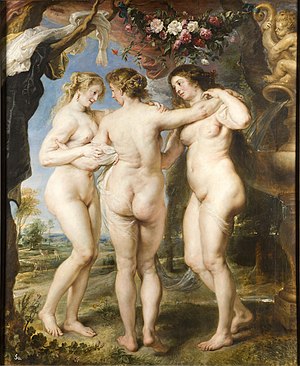
  • THE THREE GRACES


Historical and artistic context

-Time: 1636-1639.

-Style: 17th century, Baroque.

-Artist: Peter Paul Rubens.
-Material and technique: Oil on boards.

-Location: Prado Museum.


Iconographic analysis

-Name:The three Graces.

-Type of paint: This paint was done by oil and it's belong to the Baroque art.


Formal analysis

-Composition, space and decoration: 
The composition respects the classical model that represent the Graces totally nude, with a extreme white skin, and assembled, the veil that cover the Graces and the watchs produce more unit.They form a circle.The paint is colourful , warm, and with a beautiful lanscape, there are a tree, flowers and a fountain.

-Size of the paint:
221cm x 181cm


-Meaning:
The three women are characterized for the bombast of their bodies, people say that one of the woman is the wife of Rubens.The paint was donated to Felipe IV of Spain for decorate the rooms of his mansion and them for decorate the rooms of the Alcazar of Seville.